

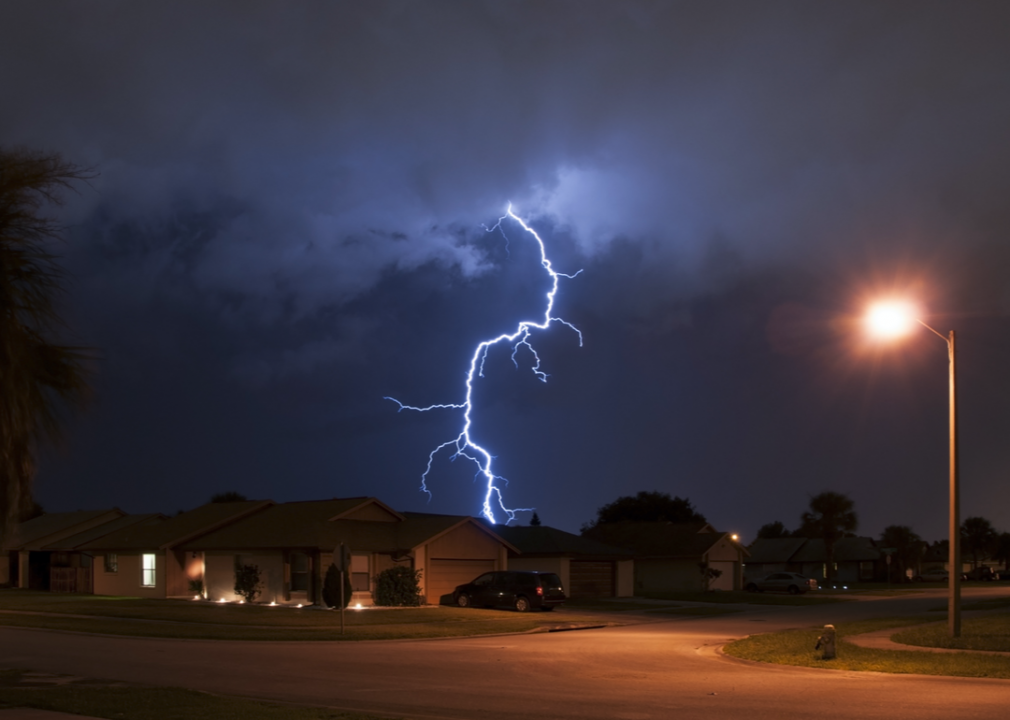
John Panella // Shutterstock
Homes are typically a homeowner’s most valuable asset, and homeowners insurance protects that investment. Recent industry analyses show that both claim frequency and average claim severity increased again in 2024—producing another double-digit rise in overall loss cost—with wind/hail and water losses leading growth while fire remains the most severe claim type per loss (2025 U.S. Home Trends Report). The U.S. also experienced extraordinary catastrophe activity: a record 28 separate billion-dollar weather and climate disasters in 2023 and another very high (near‑record) count in 2024, with severe convective storms (hail, straight-line winds, tornadoes) dominating insured losses (NOAA; Swiss Re Institute). Claims vary sharply by region—hurricanes and flood along the Gulf and Atlantic coasts, hail and straight-line wind across the Plains/Midwest/Southeast, winter freeze in the North, and wildfire in the West. Sinkholes are uncommon nationally but concentrated in karst areas like Florida and parts of Tennessee and Pennsylvania (USGS).
The ranking below follows ISO/Verisk cause-of-loss categories as summarized by the Insurance Information Institute. Current data show that fire and lightning produce the highest average payment per claim (many times larger than wind/hail or water), wind and hail generate the largest share of claim counts, and water-related losses continue to exhibit severity inflation due to longer repair cycles and material/labor costs (Triple‑I/ISO common claims; LexisNexis Home Trends).
Homeowners insurance covers the dwelling and personal property and includes liability protection if the policyholder or household members (including pets) cause injuries or property damage to others. Standard policies exclude flood and earthquake, which are purchased separately. Flood pricing has been overhauled under FEMA’s Risk Rating 2.0, while private flood options with features like additional living expense have expanded (FEMA NFIP Summary of Coverage). Coverage terms have also shifted since 2020: percentage hurricane/named‑storm and wind/hail deductibles (commonly 1%–5% of Coverage A) are more prevalent, roof settlements often use schedules or ACV in hail belts, and reinsurance-driven costs have contributed to higher premiums in high‑risk states (Triple‑I on wind/hurricane deductibles; LexisNexis Home Trends). California has linked pricing tools and wildfire‑mitigation discounts to writing commitments to improve availability, while Florida’s Citizens is phasing in a flood‑insurance requirement that materially expands take‑up (California DOI Sustainable Insurance Strategy; Safer from Wildfires; Citizens flood requirement).
Continue reading for the eight most expensive types of homeowners insurance claims—updated with the latest frequency/severity patterns, regional context, and coverage trends.

photographee.eu // Shutterstock
#8. Medical Payments and Other
– Latest ISO/Verisk 5‑year view (through 2023): lowest average claim payments among homeowners perils; infrequent compared with property losses (Triple‑I/ISO)
– Typical scope: small, no‑fault benefits for visitor injuries; not a major driver of total loss dollars
Liability splits into “Bodily injury and property damage” and “Medical payments and other.” The medical‑payments bucket is designed for minor injuries to guests regardless of fault and remains a small slice of claims by both count and dollars in the latest ISO/Verisk series (Triple‑I). Because limits are modest, average payments are typically in the low thousands. Many carriers include guidance on injury prevention and premises safety to reduce even these low‑severity losses.

Lucky Business // Shutterstock
#7. Theft
– Latest ISO/Verisk 5‑year view (through 2023): theft represents a small share of homeowners claims and carries lower average severity than major property perils (Triple‑I/ISO)
– Loss‑prevention: centrally monitored security and smart entry/lighting can qualify for insurer credits in many states (Triple‑I consumer guidance)
A police report is typically required for a theft claim. While theft’s share of homeowner losses remains comparatively small in the latest data, documentation still matters: maintain a photo/video home inventory and serial numbers for high‑value items (Triple‑I). Many carriers recognize monitored alarms and smart‑home security with premium credits, and smart‑device adoption continues to rise among U.S. internet households—supporting prevention programs that deter or shorten theft events (Triple‑I; Parks Associates).

Marina N. Mak // Shutterstock
#6. All Other Property Damage
– Composition: vandalism, falling objects, vehicle impact, and other non‑categorized losses; mid‑range severities that vary year to year (Triple‑I/ISO)
– Regional note: claim activity varies with local crime patterns and exposure to falling trees/debris from regional windstorms (NOAA)
Losses that don’t fit wind/hail, fire/lightning, water/freezing, or theft roll into “other property damage.” Examples include vandalism, broken glass from a fallen branch, or a car striking a fence. While this category is smaller than the big weather perils, multi‑storm seasons can still elevate claim counts—especially where wind‑driven debris affects outbuildings and exterior features. Insurers increasingly use drones and aerial imagery to document exterior damages and speed settlement after widespread events.

Cozine // Shutterstock
#5. Credit Card and Other
– Latest view: very small share of homeowner claims by count and dollars; average payments are modest relative to property perils (Triple‑I)
– Related risk: reported U.S. cybercrime losses reached $12.5 billion in 2023, underscoring demand for ID restoration and personal‑cyber endorsements (FBI IC3 2023)
Many homeowners don’t realize their homeowners insurance may include limited credit card fraud or ID theft coverage, and some carriers offer broader personal‑cyber endorsements. With cyber losses rising and more connected devices in homes, insurers highlight steps like multi‑factor authentication and router security; some also recognize monitored security and documented protective devices with credits (Triple‑I facts; FBI IC3 2023).

Andrey_Popov // Shutterstock
#4. Water Damage and Freezing
– Latest trend (2024 vs. 2023): frequency and severity increased again, contributing to double‑digit loss‑cost growth; non‑weather and weather‑related water both pressured severities due to inflation and longer cycle times (LexisNexis Home Trends)
– Catastrophe context: several billion‑dollar winter storms in recent years drove spikes in burst‑pipe and ice‑related claims across the North and Northeast (NOAA)
Water losses stem from freezing pipes, appliance and plumbing failures, and wind‑ or tree‑related openings that let in rain. Recent analytics show persistent severity growth for both weather‑related and non‑weather water claims, amplified by repair‑cost inflation and extended timelines (LexisNexis). Standard homeowners policies exclude flood, which is purchased separately through NFIP or the growing private flood market; NFIP limits remain $250,000 building/$100,000 contents with no additional living expense (FEMA NFIP Summary of Coverage). Prevention technology matters: insurers increasingly credit smart water‑leak sensors and automatic shutoff valves, which can materially reduce both frequency and average paid loss (Triple‑I; LexisNexis 2024 Home Trends).
stockphoto mania // Shutterstock
#3. Wind and Hail
– Catastrophe driver: severe convective storms generated record insured losses in 2023 (about $60 billion in the U.S.), with another very high year in 2024; wind/hail leads homeowner claim counts nationally (Swiss Re; Triple‑I/ISO)
– Regional concentration: hail/wind corridors across TX–OK–KS–NE–CO–MO–IL–IA and into the Southeast show elevated roof/exterior claim frequency; insurers use percentage wind/hail deductibles (often 1%–5%) and roof ACV/schedules in high‑loss areas (NOAA; Triple‑I)
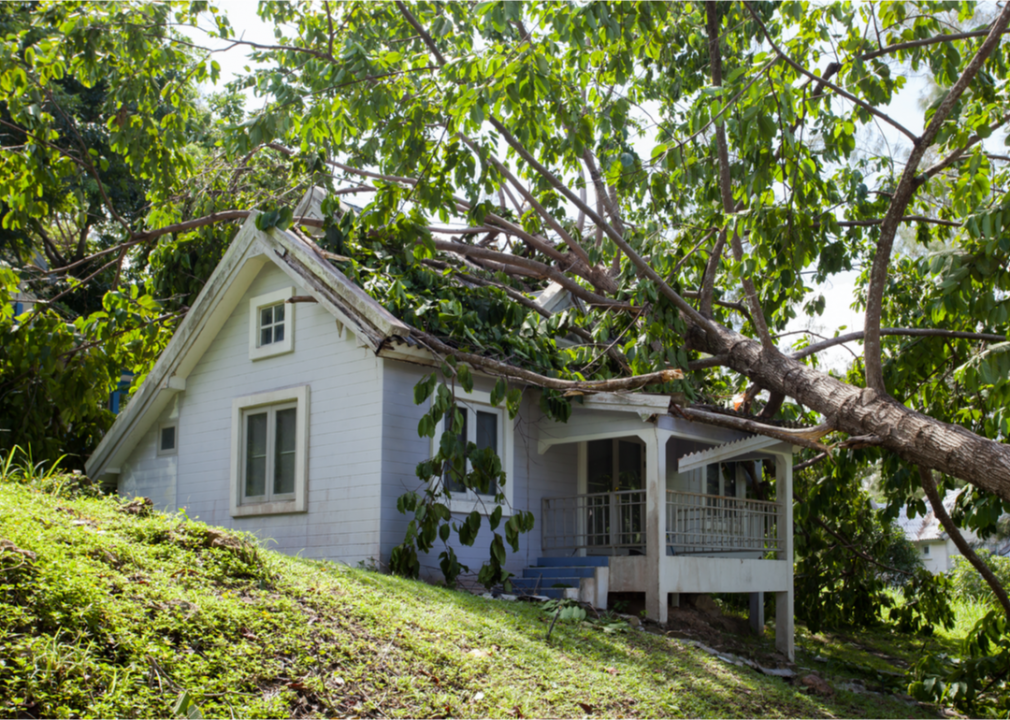
Wind and hail losses arise from tornadoes, hurricanes, derechos, and thunderstorm outbreaks. The cadence of billion‑dollar events surged, with 28 in 2023 and another very high tally in 2024, and SCS eclipsed hurricanes as the top U.S. insured‑loss peril in both years (NOAA; Swiss Re Institute). To align premiums with loss costs, many policies in hail belts include percentage wind/hail deductibles, cosmetic‑damage exclusions for metal roofs/siding, and actual‑cash‑value settlements on older roofs. Storms and winds continue to drive large claim volumes, a pattern also discussed in Triple‑I’s convective storms white paper (Triple‑I SCS analysis).

BeanRibbon // Shutterstock
#2. Bodily Injury and Property Damage
– Latest ISO/Verisk view: liability claims are far less frequent than property claims but carry higher average payments than theft and many water claims (Triple‑I/ISO)
– Common drivers: slip‑and‑fall injuries and animal‑related incidents; claim severity influenced by medical and legal cost inflation (Triple‑I dog‑bite liability)
Liability claims cover injuries or property damage that you, your family, or your pets cause others. They are a small share of claim counts but can be costly on a per‑claim basis due to medical bills and legal expenses. A frequent liability example is dog‑bite claims. Policyholders can reduce risk through premises safety (lighting, handrails), pet management, and ensuring adequate liability limits and umbrella coverage where appropriate.
wk1003mike // Shutterstock
#1. Fire and Lightning
– Latest ISO/Verisk view: highest average claim severity among common homeowners perils; per‑claim payments are in the five figures and many multiples of wind/hail or water (Triple‑I/ISO common claims)
– Lightning losses: tens of thousands of insurance claims nationwide each year, with aggregate insured losses commonly in the hundreds of millions of dollars and average paid amounts in the low‑to‑mid five figures in active years (Triple‑I lightning claims)
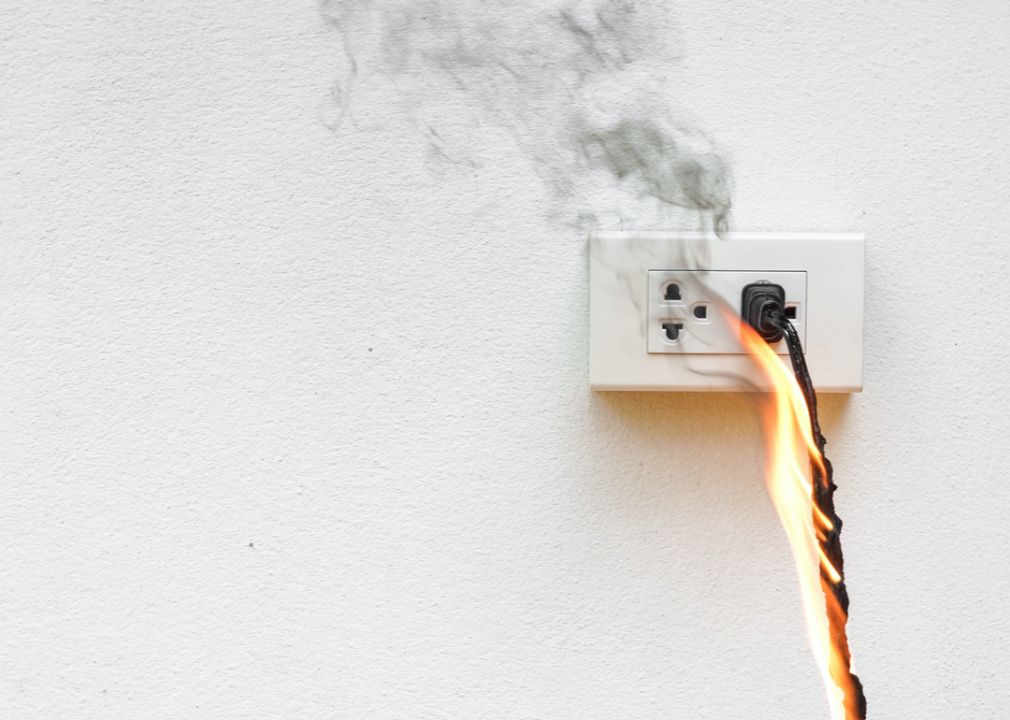
Fire and lightning produce the costliest homeowners claims on a per‑claim basis. NFPA’s national fire statistics show multi‑billion‑dollar direct property damage annually and an average direct dollar loss per structure fire in the five figures, underscoring the hazard’s inherent severity (according to the National Fire Association). The leading cause of home fires is cooking, but wildfire and lightning amplification also matter: Western states—especially California—have the greatest concentration of properties with elevated wildfire risk, and lightning routinely sparks thousands of incidents each year (according to a wildfire risk analysis; National Fire Protection Association). Prevention and resilience pay off: interconnected/monitored smoke alarms cut the home‑fire death rate roughly in half versus homes without working alarms, and insurers increasingly recognize wildfire‑hardening measures (Class A roofs, ember‑resistant vents, defensible space) with premium credits where filed (NFPA smoke alarms; Safer from Wildfires credits). Industry studies also document continued severity inflation for large‑loss perils like fire/lightning due to rebuilding‑cost pressures (LexisNexis Home Trends).


