

Yes, “bomb cyclone” really is the technical term for a rapidly intensifying mid‑latitude storm whose central pressure falls extremely fast. The American Meteorological Society defines an explosive cyclone (a “bomb”) using the Bergeron criterion: a sea‑level pressure drop of about 24 hPa in 24 hours at 60° latitude, scaled by latitude (AMS Glossary). These storms are most common over the North Atlantic and Northwest Pacific in the cool season, where sharp ocean temperature gradients and strong jet streams favor “bombogenesis” (ECMWF).
“What makes a storm a ‘bomb’ is how fast the atmospheric pressure falls,” explains New York Times science reporter Henry Fountain. Forecasters apply a latitude‑adjusted 24‑hour pressure‑drop threshold; the rapid deepening is called “bombogenesis.” Many recent oceanic cases have reached central pressures below ~960 hPa before land impacts, consistent with long‑term climatology (ECMWF) and educational summaries from UCAR.
To give you a clearer picture of what that looks like: over the ocean, rapidly deepening storms can briefly achieve pressures comparable to Category 1 hurricanes before weakening near landfall—said CNN Meteorologist Brandon Miller. In recent seasons, notable rapidly deepening storms included a powerful Atlantic system that hit the UK and Ireland (Storm Isha, Jan 2024) with widespread 60–80+ mph gusts (Met Office) and a major Pacific storm that explosively deepened offshore of California in early Feb 2024 (UCAR).
These systems can deliver damaging winds, heavy snow or rain, coastal flooding, and multi‑day power outages. In the U.S., winter storms remain high‑impact: NOAA’s Billion‑Dollar Disasters database documents the central‑U.S. winter storm and cold wave of February 2021 at roughly $26 billion, and it lists multiple billion‑dollar winter storms in January 2024 (NOAA NCEI). Grid assessments warn that extreme cold during such storms can trigger energy emergencies across the central and eastern U.S. (NERC 2024–2025 Winter Reliability Assessment).
Here’s what to consider for potential damages and homeowners insurance claims if your home is in an affected area.
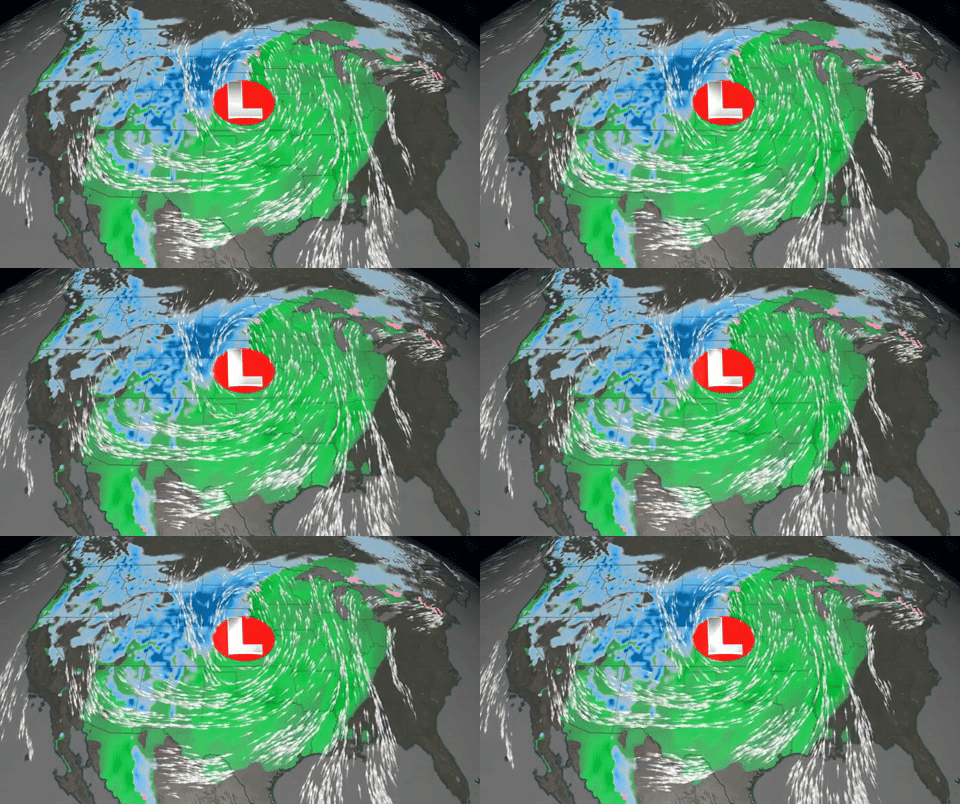
How a Bomb Cyclone Could Affect Your Home
Since 2020, reanalysis‑based climatologies show that the Northern Hemisphere typically sees dozens of explosive cyclones each cool season, with the Northwest Pacific leading and the North Atlantic close behind; downstream impacts can reach the central U.S. when lee cyclogenesis east of the Rockies rapidly intensifies into blizzard‑producing systems (ECMWF) (UCAR). Here’s what that means for homeowners:
Hurricane-force wind gusts: “Hurricane‑force” refers to winds that reach sustained speeds of more than 74 miles per hour. Rapidly deepening cyclones routinely produce widespread 60–80+ mph gusts over land and higher over water, leading to roof, siding, and fence failures as well as widespread tree damage (Met Office; ECMWF).
Extreme winds can cause damage to homes through downed trees and poles, flying debris, and the failure of weaker building openings. In wind events, reinforced garage doors and well‑attached roof edges materially reduce losses; when reroofing, the IBHS FORTIFIED Roof standard’s sealed deck and enhanced edges can cut interior water intrusion by up to 95% if shingles are lost (IBHS).
Blizzard conditions: “Blizzard conditions” include heavy or blowing snow, reduced visibility, and wind speeds of at least 35 miles per hour over a sustained time period. Use the National Weather Service’s impact‑based Winter Storm Severity Index to anticipate timing and severity and to plan safely.
Winter storms drive high insurance losses in the U.S., with damages from falling tree limbs, weight of snow and ice on roofs, and wind‑driven rain. NOAA tracks these events in its Billion‑Dollar Disasters database—documenting, for example, the ≈$26B central‑U.S. winter storm and cold wave in 2021 and multiple billion‑dollar winter storms in January 2024 (NOAA NCEI). For coverage specifics on winter perils, see the Insurance Information Institute’s guidance (III).
Flood threats Flooding and storm surge are handled separately from wind in insurance. Standard homeowners policies exclude overland flood; coverage requires a separate flood policy (NFIP or private). NFIP covers building/contents up to federal limits and includes up to $30,000 in Increased Cost of Compliance for eligible substantial‑damage mitigation; it does not cover Additional Living Expenses and generally has a 30‑day waiting period with limited exceptions (FEMA FloodSmart) (FEMA Manual). Sewer or sump backup requires a separate homeowners endorsement and is distinct from flood.
Water damage can affect foundations, basements, belongings within the house, and utilities. Note that damage to vehicles on your property from wind, falling trees, or flood is typically covered by your auto policy’s comprehensive coverage—not by homeowners insurance; contact your auto insurer to confirm.
Homeowners Insurance Covers Most of These Threats
It’s important to note that damage from flooding is not covered by homeowners insurance. You’ll only be able to file a flood‑related claim if you have a flood insurance policy through the National Flood Insurance Program. NFIP premiums now use property‑specific Risk Rating 2.0 (new business from Oct. 1, 2021; renewals from Apr. 1, 2022) with annual change caps; Elevation Certificates are optional but can help, and private flood options have expanded in recent years (FEMA Risk Rating 2.0) (NAIC Private Flood) (FHA acceptance of private flood).
Besides flooding, a standard homeowners insurance policy typically covers wind damage, weight of ice and snow, and sudden and accidental water damage from burst pipes (if you maintained reasonable heat). Many policies include separate wind/hail deductibles; hurricane or named‑storm deductibles generally do not apply to non‑tropical systems like bomb cyclones (NY DFS) (III).
You’d be able to file a claim for damage due to falling branches or heavy snow on your roof, windows broken by flying debris, and burst frozen pipes. If the loss makes your home uninhabitable, Additional Living Expenses (ALE) can help with temporary housing. For flood, NFIP does not include ALE but does provide up to $30,000 Increased Cost of Compliance for eligible mitigation after substantial damage (FEMA Manual).
See the Insurance Information Institute’s resource on filing a homeowners insurance claim after a catastrophe for more information. For state‑specific guidance on wind versus flood, wind‑driven rain, tree damage, food spoilage, and sewer backup endorsements, consult your state regulator—e.g., Washington OIC and California DOI. If both wind (covered) and flood (excluded) contribute to a loss, anti‑concurrent causation clauses can affect outcomes—promptly document wind damage before floodwaters arrive if safe to do so.

Homeowners Can Take These Steps to Prepare
Make safety your first priority. The Red Cross offers helpful tips on safety and winter storm preparedness here. Also monitor impact‑based forecasts via the NWS Winter Storm Severity Index, keep redundant alerts (NOAA Weather Radio and Wireless Emergency Alerts), and prepare for outages with battery‑backed carbon monoxide alarms and safe generator practices (NWS) (CDC). If reroofing or upgrading, FORTIFIED Roof details like sealed decks and enhanced edges, plus garage‑door bracing, tree maintenance, whole‑house surge protection, and smart leak sensors (with automatic shutoff) can materially reduce losses (IBHS) (IBHS Frozen Pipes).
Options for damage‑proofing your home are fairly limited on the day of a storm. However, if the weather hasn’t quite reached you yet, there are a few steps you can take right now to reduce the likelihood of winter‑storm related damage:
- Remove loose objects and debris from your yard or driveway so they don’t become wind‑borne projectiles; secure trash bins, grills, and patio furniture. Use NWS watches/warnings and the WSSI to time actions 24–72 hours ahead.
- Make sure freestanding objects in the immediate vicinity are tightly secured; brace wide garage doors to reduce wind failure risk and check roof edge/drip‑edge fasteners if you’re safely able to do so.
- Park your car in the garage if possible, or well away from trees and power lines; remember that storm damage to vehicles is typically an auto comprehensive claim rather than a homeowners claim.
- Run your hot water periodically or let it drip to keep pipes from freezing; open sink cabinets on exterior walls and consider activating heat‑trace cables on vulnerable runs (IBHS).
- Keep your attic cold by sealing air leaks and improving insulation to reduce ice dams; maintain clear soffit/ridge vents.
- If you have time and are able to safely do so, clear your gutters and/or your roof before new snow accumulates; use a roof rake from the ground to reduce load at eaves and prevent ice dams. Consider battery‑backed sump pumps and whole‑house surge protection ahead of time.
More Resources for Homeowners in the Central U.S.
If you need to file a homeowners insurance claim for wind- or snow-related damage, use this checklist from the Insurance Information Institute as a guide. Review your declarations for wind/hail deductibles, roof coverage basis (replacement cost vs. ACV), and any cosmetic-damage limitations. State regulator pages like Washington OIC and California DOI explain wind-driven rain rules and tree/food‑spoilage sublimits.
If you need to file a flood insurance claim, follow the steps in this brochure from the Insurance Information Institute. NFIP policies are rated under Risk Rating 2.0 with capped annual premium changes; coverage limits and terms (including no ALE, general 30‑day waiting period with limited exceptions, and up to $30,000 ICC) are outlined in FEMA’s resources here and the program overview here.
Before you file a claim, see this article for tips about successfully filing a homeowners insurance claim after a major disaster. Document wind damage before any flooding if safe, keep receipts for emergency repairs, and remember that storm damage to vehicles is generally an auto comprehensive claim, not homeowners (state regulator guidance).
Protect yourself against future winter storms: See the Red Cross’s advice on winter storm preparedness, preventing frozen pipes, and safe backup generator use. For forecast awareness and tech advances improving warning lead time, monitor NWS products and NOAA satellites, and note that ECMWF’s 2024 model upgrades and AI guidance aim to improve rapid‑deepening forecasts (NWS) (NOAA GOES‑U) (ECMWF 49r1) (ECMWF AIFS) (AR Recon).


