

Connecting to the internet now spans everything from coffee-shop chats to smart smoke detectors syncing in the background. Real‑world speeds have climbed markedly: global median fixed‑broadband downloads currently sit well above 100 Mbps and global mobile is in the mid‑50 Mbps range, according to the live Speedtest Global Index. At the same time, hybrid/remote work has stabilized at roughly 28–30% of paid U.S. workdays, which keeps daytime, upload‑heavy traffic high in homes (WFH Research). With multiple credible options at most addresses, the best choice depends on technology, reliability, and total cost. Below we compare the major connection types using current performance evidence and 2025 program developments.
A brief breakdown of your options
Each connection type is defined by its access technology — the physical medium and radio spectrum used to move your data — and those choices directly affect speed, latency, and consistency under load. Independent panels such as Ofcom’s Home Broadband Performance, Australia’s Measuring Broadband Australia, and the FCC’s Measuring Broadband America consistently show fiber leading, followed by cable, with legacy copper DSL last on most reliability measures.
DSL: Short for “digital subscriber line,” DSL uses existing copper telephone pairs. Performance is distance‑dependent and generally trails newer options; typical plans run roughly ~10–100 Mbps down with single‑digit to low‑tens Mbps up on VDSL where available. Regulator test panels (e.g., Ofcom) and the FCC’s MBA find DSL significantly slower with higher latency than fiber or cable.
Cable: Uses hybrid fiber‑coax (HFC) with DOCSIS. Common download tiers span ~200 Mbps to 1–1.2 Gbps, with multi‑gig downstream and much higher uploads emerging as DOCSIS 4.0 rolls out. DOCSIS 4.0 enables multi‑gig downstream and substantially higher upstream capacity (including symmetrical profiles with full‑duplex implementations) over existing HFC (CableLabs).
Satellite: Two categories now matter for consumers. LEO services (e.g., Starlink) typically deliver ~50–150+ Mbps down with median latency ~30–60 ms depending on load (Ookla Insights: Starlink). Traditional GEO systems (e.g., HughesNet’s architecture) have improved throughput but still exhibit latency in the hundreds of milliseconds due to orbit altitude.
Cellular: Mobile broadband via 4G/5G. On phones, recent U.S. 5G measurements show typical median downloads around 100–200+ Mbps with improved latency versus 4G (Opensignal USA 2024), and global 5G averages near ~200 Mbps (Opensignal Global 5G). For home internet, 5G fixed wireless access (FWA) commonly advertises ~50–300+ Mbps depending on coverage and load (T‑Mobile 5G Home; Verizon 5G Home).
Fiber-optic: Delivers data over glass strands as light. Typical residential tiers range from 300 Mbps to 1–2 Gbps, often symmetrical, with multi‑gig options in many metros. Independent panels find fiber has the lowest latency and highest busy‑hour consistency among fixed access types (Ofcom; FCC MBA). Availability continues to expand in 2025 via public programs (e.g., BEAD; USDA ReConnect) and private builds (see new city launches on the GFiber Blog).
“Fiber’s growth potential is theoretically limitless, which no other physical medium can claim…In an ideal world, all internet connections would be fiber.”
Trevor Textor, Project Manager, Rural IT & Connectivity Consultant
Speed is a defining factor
Independent measurement programs show large gains since 2020. The Speedtest Global Index currently reports global median fixed downloads above 110 Mbps and global mobile in the mid‑50 Mbps range; median fixed latency is typically single‑digit to low‑teens milliseconds depending on market mix. 5G delivers roughly an order‑of‑magnitude improvement over 4G for downloads globally (~200 Mbps vs. ~25–30 Mbps), with lower latency (Opensignal). For a current U.S. snapshot, consult the U.S. entries on the live Global Index (values update monthly).
DSL remains the slowest common fixed option. Real‑world capability typically tops out at tens of Mbps on long copper loops, with VDSL variants reaching higher where loops are short. Regulator panels (Ofcom) and the FCC’s MBA show DSL lagging on both speed and latency, making it best suited for light needs (basic browsing/email) rather than multiple concurrent HD/4K streams or heavy cloud backups.
With satellite internet, modern LEO options commonly deliver ~50–150+ Mbps down with ~30–60 ms median latency in many markets (Ookla Insights: Starlink). Traditional GEO providers like HughesNet and Viasat can offer higher throughputs than in years past but inherently have latency in the hundreds of milliseconds, which affects interactive apps (e.g., gaming, real‑time collaboration).
Cable internet is a strong fit for most homes. Typical download tiers range 200 Mbps–1 Gbps+, and DOCSIS 4.0 upgrades are beginning to add multi‑gig downstream and materially higher uploads in select markets (CableLabs). Latency is usually higher than fiber but well below DSL in independent tests (Ofcom).
Fiber is the current speed and latency leader. Where available, you’ll often find symmetrical tiers from 300 Mbps up to 1–2 Gbps, with multi‑gig offers in many metros. National panels show fiber ISPs consistently delivering or exceeding advertised rates during busy hours with the lowest latency among fixed technologies (Ofcom; FCC MBA).
Cellular internet now serves both mobile and home needs. Typical real‑world 5G downloads in the U.S. land around 100–200+ Mbps, with availability rising thanks to mid‑band deployments (Opensignal USA 2024). For home internet, fixed‑wireless offers commonly advertise ~50–300+ Mbps depending on location (T‑Mobile 5G Home; Verizon 5G Home). At peak, 4G LTE can still reach 50+ Mbps. The next step, 5G‑Advanced (3GPP Release 18), completed in 2024, sets up further efficiency and capacity gains into 2025–2026 (3GPP).
Reliability is important too
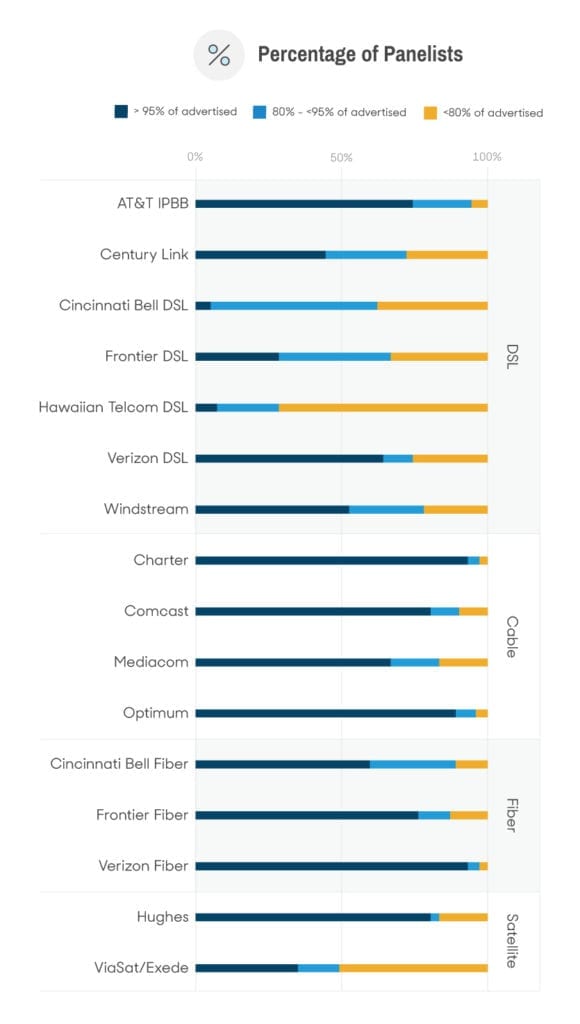
“Reliability” spans uptime/outage frequency, busy‑hour consistency, and network quality (latency, jitter, packet loss). 2025 regulator measurements show a consistent ranking by access tech: fiber‑to‑the‑premises has the fewest outages and lowest latency/packet loss; cable/HFC ranks next; DSL/VDSL trails (ACCC; Ofcom 2025). The ACCC defines an outage as any ≥30‑second interval with no data transfer. Typical latency ranges reflect this: fiber often ~5–20 ms; cable in the low double‑digits; DSL higher; LEO satellite ~30–60 ms; GEO satellite in the hundreds of ms (Speedtest Global Index; Ookla Insights).
Current U.S. analytics likewise favor fiber. Ookla’s Q2 2025 market report shows fiber‑led ISPs with the best fixed‑broadband “Consistency” and lowest latency, with cable close behind and DSL far back (Ookla U.S. Market Report Q2 2025). Large U.S. cable operators also report very high network availability—Comcast cites >99.9% availability in recent ESG reporting (Comcast Impact/ESG), consistent with HFC’s strong but slightly behind‑fiber reliability profile.
What’s best for you?
Start by checking which technologies serve your exact address. Use the FCC National Broadband Map and state broadband portals, and confirm providers’ availability pages. Public programs are expanding options in 2025: the $42.45B BEAD program is moving from planning to awards and fiber builds; rural projects funded via USDA ReConnect are lighting up new FTTP in previously unserved areas; and private expansions continue city by city (see the GFiber Blog). As new builds go live, they appear in the FCC’s semiannual Broadband Data Collection and on the National Broadband Map.
If you have multiple options, compare plans against your household’s usage. Remote/hybrid work elevates mid‑day and upstream demand—multi‑party video, VPN, and cloud sync—so favor higher upload capacity and lower latency for reliability during work hours (OpenVault OVBI; Sandvine; WFH Research). Consider how many people and devices will be online and the mix of activities (4K streaming, gaming, backups, smart‑home devices).
After years of internet research and consulting network experts, we’ve built a guide to help you gauge the internet speed that will best fit your household. The recommendations below reflect today’s higher baselines (4K streaming, cloud backups, hybrid work) and include upload guidance, which matters for video calls, creator workflows, and large file sync.
| Light Use | Moderate Use | Heavy Use | Very Heavy Use | |
| 1-3 devices | 50/10 Mbps (down/up) | 100/20 Mbps | 200/20 Mbps | 300/50 Mbps |
| 4-8 devices | 100/20 Mbps | 200/20 Mbps | 300/50 Mbps | 500/50 Mbps |
| 8-10 devices | 200/20 Mbps | 300/50 Mbps | 500/50 Mbps | 1,000/100 Mbps (1 Gbps) |
| 10+ devices | 300/50 Mbps | 500/50 Mbps | 1,000/100 Mbps | 2,000/200 Mbps (multi‑gig) |
From there, you should compare price, fees, and overall value. Use the FCC Broadband Consumer Label at checkout to see typical performance, promo vs. standard price, and any fees. If you have more questions, check out our detailed guide to internet providers.
What’s Next?
- Compare your options in our review of the best internet service providers.
- Read more about the difference between fiber and cable technology.
- For gamers and hardcore internet users, we have a gamer’s guide to internet speeds.


